By Gregory J. Palmerino
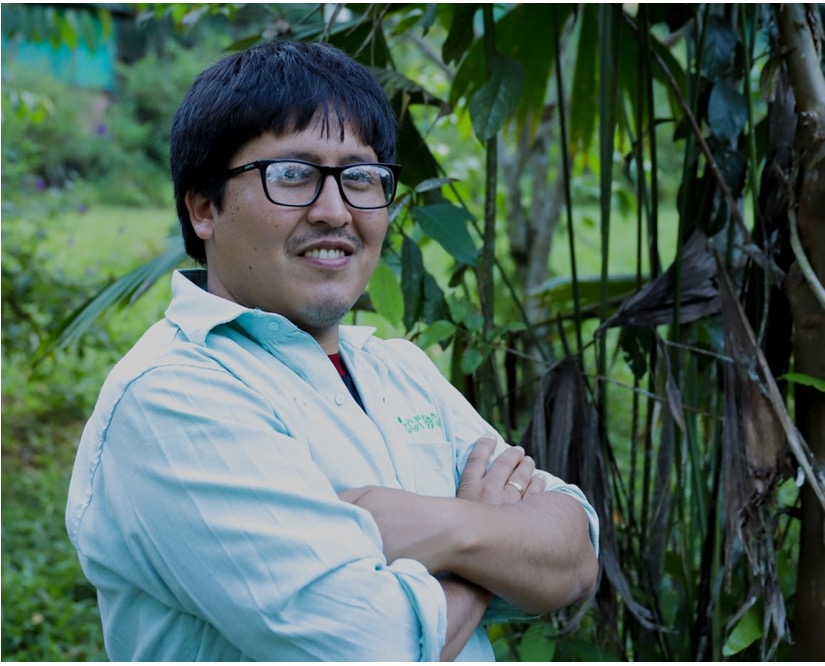
When we think about careers in conservation often our first thoughts are of muddy scientists hiking through the forest with binoculars and notebooks or photographers lurking behind trees waiting to capture the perfect shot of a soon to be insta-famous animal. What is rarely considered are the people that work behind the scenes ensuring funding, transportation, staffing, housing—all of the things that make it possible for those of us in the field to do our jobs. Edgar Marquina is one of those people who works tirelessly to ensure the conservation machine that is the Crees Foundation stays running. A biologist and insect enthusiast himself, Edgar uses his genuine passion for research, conservation, and the native communities of Peru to guide his work as the Program Manager of the Crees Foundation.
Sitting with Edgar in the field office of the Manu Learning Center and speaking to him about his role was inspiring. Not only because of the clear joy and excitement he has for conservation and science, but also due to his genuine and humble spirit.
Q: What Inspired you to follow the path of science?
A: I think I was lucky to meet some people with very interesting points of view that really knew that they could create a legacy that inspires and supports other people. The only way to build that legacy—something specific for your country, for your town, for the people around, is to use science for that purpose. My purpose is to generate improvements around me—in the people and places around me by using science. Science is the perfect tool to make everything around us better.
Q: Who are some of the people who inspire you?
A: In 2019 after I finished my undergraduate thesis I spent a few months in Argentina working in a research institute’s museum—La Fundacion Miguel Lillo. I went with so many ideas—one of my purposes there was to meet some famous researchers, Pablo Goloboff and Claudia Szumik and learn from them. They both are really amazing people—they are both top rated in their fields. Pablo is a methodologist on quantitative phylogeny. His wife, Claudia, is a researcher in Biogeography which is one of my most preferred fields in biology. I met them and they were really friendly—not pretentious at all—down to Earth. I was working in the lab one day and Pablo even knocked on the door and invited me to go to coffee with them—I was like, “Oh man, you’re inviting me to go with you?!” It was so crazy. That’s why I take it so seriously, science research is to serve other people, to serve the society. What you learn, what you know is for one purpose and it is to share it with other people. So my main purpose is to make improvements here, with Crees and with the people.
Q: When did you discover the Crees Foundation?
A: It was 2015 or 2016 and one of my classmates at University was taking part in a project that someone at the MLC was working on in that moment. So she—my friend—became a research assistant for a researcher that was conducting a project with Crees. Through her I met Juan Carlos, the general manager of the Manu Learning Center. The first time I worked for Crees I was working as a guide who came here with a group of 10-12 people from the U.S. who were etymologists. Then, in 2017, I was supporting Crees in Cusco giving advice, participating in meetings, sharing my experience—many things. Juan Carlos at that time was pushing me to join the team but at that moment I was working on my undergraduate thesis at UNSAAC and that was my priority.
Q: When did you begin working for Crees?
A: In my last days in Argentina in 2019 I got a call from Juan Carlos. When I got back to Peru I went into the office and we talked a bit about the chance for funding a project—it was 100,000 soles, close to $30,000–not too much money but it was my first opportunity to start a real project inside of an organization. I started just as research manager, not research coordinator so I wasn’t directly involved in the work but was outside giving him support.
Q: What was the project?
A: The project which I generated funding for was based on studying insects as bio indicators for land use types. I’m very thankful for Crees—this has been my first opportunity to be in charge of a team of people, to run an NGO specializing in Conservation.
Q : Insects huh? Do you have a favorite?
A: Oh yeah, I really like Wasps. Wasps moved me to Argentina everything was all about wasps. As bio indicators, their biology, their evolution—how they live, it’s crazy. They have so many particular ways of life. Spider wasps are very interesting—they hunt spiders, kill or paralyze them, carry them up to their nest, lay their eggs next to it and their larvae grow and feed off that spider—crazy.
Q: What would you say is the primary activity of your current role?
A: The Crees Foundation is working in Cusco, in Salvacion, in the MLC—sometimes in Romero or Diamante—when you have to send someone to any of these places there is a whole lot of coordination involved—many calls, many documents. I’m in the middle—working for the founder, the people who run the foundation and under me there are the people who are really doing the fieldwork. I am the middle between those two points.
Q: What is your favorite part of your job?
A: Wow, my favorite part of my work is being in a native community like Diamanté. Speaking with the people and hearing their histories—hearing that so many of the things I’ve heard in the past are true. That they have lived that part of the history. When you hear them speak, so many things start making sense. I spoke a lot with them about the indigenous people and the first contacted people. They are so smart, so clever, and they are not biologists or sociologists, they are just part of the community. My favorite part is when I have the chance to recognize that many other people know more than me and I’m just learning from them and getting involved in the whole process that is taking part.
Q: What is your least favorite part of your job?
A: I’m not doing the science which is a bit of a problem for me, but I am the face of the fieldwork and science to the higher ups in the organization, advocating for the work that is being done—to move the people towards their purposes which balances it out.
Q: What is the best thing about working for the Crees Foundation?
A: Crees is a really well respected organization by people around here. People love Crees, they know who we are, they know that we are kind respectful people and work in the same way.
Q: What is your ultimate career goal?
A: I’ve been thinking about that—I would like to start a PhD soon in general biology. There are many options but I have to be honest with you, I’m not looking for any specific program but I know that the opportunity will arrive. It will be in front of me and I will know. When I had my experience learning in Argentina, things just happened. Everything was so easy and the experience was so successful and everything was done before I even had to make a decision. So I’m not sure—and I don’t want to be sure I just want to have the news in the moment and let it happen.
 Gregory J. Palmerino