By Greg Palmerino
I was in Nicaragua on a bus jostling along a jungle lined road headed to San Juan del Sur, with four other young travelers when it was discovered—after three hours of driving—that the other passengers had not paid. The driver, a middle-aged Nicaraguan man who spoke little English stopped the bus and was arguing with the travelers, who themselves spoke little Spanish. Grateful that this little drama did not involve me, I wandered down the side of the road, admiring the jungle and searching for the creatures that are never too far from its branches.
Peering through the vines I was quick to discover that this was indeed no jungle. No, this was a strategic display—a green screen designed to maintain the ignorance of what lay beyond. Moving closer to the faux jungle I brushed away a branch and saw a sight that chilled my heart—a wasteland of trash. Acres of it. nothing but waste and decay extending far past the horizon, further than any eye could see. Seagulls and flies swarmed and mingled amongst the garbage—the only life to be seen.
Returning to Long Beach, California after my travels, the memory of the Nicaraguan landfill haunted me. Every time I would see trash piling up in my apartment or being blown about on the streets, the image of the endless waste would burn in my mind. After all, my community was not immune.
According to the Long Beach City website:
“Each year, the residents and businesses in Long Beach throw away approximately 368,000 tons of residential, commercial, and industrial waste. That’s 1,494 pounds for each man, woman, and child in Long Beach!”
The amount of waste that a person consumes in a lifetime is almost unfathomable yet very real. So real in fact that cities such as Long Beach are waking up to the need to end our current system of waste. In an open letter to Senator Ben Allen in 2019, Patrick H. West, city manager, voiced the support of the City of Long Beach for the California Circular Economy and Plastic Pollution Reduction Act. California’s state website, Cal Recycle recently began promoting the emerging “zero-waste” movement, defining it as:
“…a process and a philosophy that involves a redesign of products and consumption, so that all material goods can be reused or recycled—or not needed at all.”
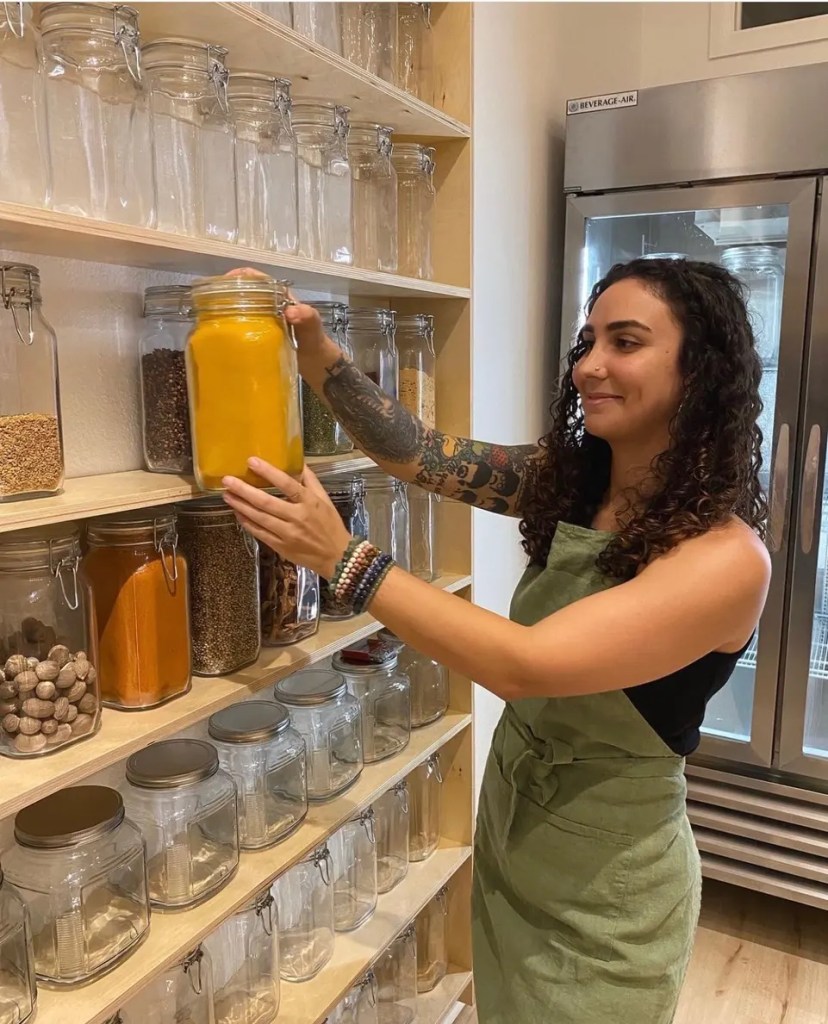
Enter Katy Impellizzeri—a Long Beach resident committed to enacting change. Waste is certainly nothing new to Impellizzeri, every week you can find her, along with her 3-pound rescue chihuahua christened Coco, walking along Alamitos Beach cleaning up trash for what she has dubbed, “trashy Tuesdays.”
Now, at the age of 30, Impellizzeri is opening Long Beach’s first package free, zero-waste, and vegan grocery store: Ethikli.
Q: I noticed that your brand Ethikli is spelt with a “K-L-I” instead of the traditional spelling—what’s the story there?
A: Yes—that name came to me at about 2 o’clock in the morning. I was lying in bed and had been trying to think of a name that could include a word with my initials, KLI and suddenly, I just thought of Ethikli. Katherina Lucia Impellizzeri.
Q: That is quite the name. What is your family heritage?
A: I am Sicilian mostly—my father is Sicilian, I’m first generation to be exact and my mother is English Irish German- quite a few things, she’s just kind of a mutt.
Q: Does that mean your father is an immigrant?
A: Yes! Yes.
Q: How has his journey shaped your entrepreneurial spirit?
A: From the moment they moved here, even my grandparents—my grandmother, my nona, she didn’t work but my grandfather, my nono—he was a chef and he worked extremely hard. My dad was inspired by how hard my grandfather worked and needed to work to help support the family—he was the only one who spoke English too at the time—so he was kind of doing everything for the family being the oldest kid. He started a hair salon, his first business, but he pivoted and got into the deli/restaurant business.
So yeah, the entrepreneurial spirit is in the family, especially on my father’s side.
Q: What was your initial inspiration for your brand, Ethikli?
A: Where do I begin? I guess we could go back to middle school when I first saw a PETA video that showed factory farming and what happens behind the scenes that they kind of hide from us, that they don’t want us to know about. It took one video to turn me vegetarian and that kind of started my path on investigating what else are we being lied to about. Then out of high school I really got serious about it. There was a long stint there where I was trying to go completely zero waste.
Q: Now what does the term “zero-waste” mean to you?
A: Well initially zero-waste meant to go all out—no plastic whatsoever, super strict. Now I’ve realized that it is very difficult to avoid plastics and to me, zero waste is using what you already have, not buying in excess. Mindfully consuming and mindfully tossing away. Mindfulness in the way that we consume and in the amount that we consume. Using what we already have to the best of its ability until it is completely done and then getting rid of it in a mindful way. Repurposing it, reusing it and recycling it.
Q: How much waste do you yourself generate daily?
A: Daily I’ve gotten to the point where most of my waste is aluminum cans or food scraps which I mostly compost but—TAKEOUT. THAT is probably my biggest thing. You know when I’m lazy and I don’t feel like cooking I go and get takeout somewhere and inevitably they have some sort of single use plastic which I then wash and repurpose and give away to friends with leftovers or—I have a lot of empty single use containers in my closet right now. [laughs] I’m trying to find a way to repurpose those.
Q: What was the hardest thing for you to replace when transitioning to a zero-waste lifestyle?
A: Great question, well I would say cosmetics and hair products. I just found a conditioner bar and curl crème that is plastic and package free, and I’m so stoked. I have been looking for years for a good conditioner and curl crème for my hair and I felt so bad buying plastic containers of it but what could I do? I need to do something with my hair so—
Q: What then do you think is the biggest impediment for people in making these eco conscious decisions in their daily lives?
A: Convenience. Absolutely convenience, number one thing I mean—I just said I’m too lazy to cook so I go and get something from a restaurant that comes in plastic, so—you know a lot of the convenience nowadays comes in little bite sized or meal sized packaging that is very convenient. We’re just on the go all the time and we live in this society where more is better and fast is better and we don’t necessarily think about what we are eating. We just want it to be fast, easy, and yummy.
Q: How do you keep your products fresh without the use of air sealed plastics?
A: Air sealed glass containers. There is an argument that glass isn’t necessarily sustainable because of the production process of it, I think it depends on where it is manufactured but if you recycle glass, it can be more sustainable and it’s also healthier because you don’t have the plastics leaching into your food, one of my personal concerns when it comes to plastic. Stainless steel is an option—I’m still investigating the manufacturing process in that but at least it lasts a long time, and it is food grade. If you store your food in a sealed airtight glass or steel container it lasts a really long time, especially dried beans and rice it can last years in those containers.
Q: What was your primary motivation for opening your storefront?
A: Well to be honest, opening a package free grocery store has been my dream for over 8 years now, before I even moved out to California from Virginia. I had seen a video where someone was doing it, I think somewhere in Europe of course—they’re ahead of us in terms of the zero-waste movement—but that inspired me and put the idea in my mind.
I put it on hold while I pursued my career teaching yoga—but then the pandemic closed all the yoga studios, and I found myself considering other options. Something that would be for lack of a better word—sustainable. I was like, this is just a great time. I started online first but I saw after doing the pop ups that people respond better when they can see the products in person. So that’s what really pushed me to start looking for a storefront. Now is the time, I’ve got an investor—my father—he’s been squirreling money away and waiting secretly for this to happen. I think he knew that I was going to be ready at some point to start a business.
Q: What is it about Long Beach specifically that made you decide to open your shop there?
A: The moment I moved here I just felt so at home—like my people are here. Everything that I believe in, a lot of the people here believe in the same things, share the same values. I moved here and looked for a package free grocery store because I thought—it’s Long Beach they have got to have a package free shop somewhere! They do, BYO Long Beach, they have a similar concept, but they focus more on bath and beauty. They are amazing, they’re awesome.
Q: What is the product focus for the flagship of Ethikli?
A: Because they are there, I wanted to compliment them and not be competition. Our focus is on groceries—edible food products like beans, rice, dried foods… I’m also going to have breads nuts, vegan cheeses, fresh milks, and butters—our focus is food.
Q: How much of a person’s grocery shopping will they be able to do at Ethikli?
A: That’s a good question, and it will depend on the person. One person could do probably 90 percent there and someone else would probably be closer to 60 percent.
Q: That someone else, what would be the defining characteristic between 60 and 90 percent?
A: If you’re someone who is a super clean eater, and you are completely vegan, you would be closer to the 90 percent. That’s another thing, we are 100% vegan, it was a tough decision to make, but those are my values and I decided I did not want to have any animal products whatsoever.
Q: What would you say to an omnivore who is thinking about shopping at your store?
A: I think that you can still get a lot of what you need and maybe come in and try the plant-based cheeses and the plant-based milks. You don’t have to give up meat all together. Buy your side dishes with us.
Q: You mean you’re not going to chase them out of the store?
A: No…no, no—I’m not that type of vegan. I’m very excepting and I know that animal products have been around for as long as humans have been around.
Q: What are your thoughts about potentially carrying humane and ethically sourced animal products at some point down the line?
A: That’s something that I’ve considered because there is a need for locally sourced, humanely sourced animal products which is why I was considering it. I think when I can expand to a bigger space, I would consider it again because I’m realistic about it and I know that not everyone is ready, may not ever be ready to become a vegan. I would love to meet them somewhere in the middle.
Q: What products do you think that people are going to be the most excited about?
A: Well, this is probably what I’m most excited about—we are going to make our plant-based milks in house so those are going to be really fresh—our plant-based cheeses are also really phenomenal.
Q: What precautions are you considering as it concerns covid19 safety?
A: Well the good thing about being mostly a grocery store is we are considered an essential business so we hopefully won’t ever have shut down completely—and I am planning on offering local delivery and pick up options so if we do need to close our indoor facility for customers I can still deliver foods and we are still going to operate online, so you can get anything from our store delivered to your doorstep.
Q: What would you say the biggest obstacle you face when sourcing products?
A: Getting a response! You can normally tell if a vendor is not genuinely ethical if they will not respond to you. You can see that they read your message and they just totally ignore you. It’s generally the bigger companies that started off small and then are big and you’re like—oh you must have pivoted to lower the cost of your goods, by outsourcing or offshore manufacturing.
Q: As you grow as a company is there any concern that is what is going to happen with Ethikli?
A: Absolutely not. The whole premise and foundation of Ethikli is to not be a big greedy corporation. That is what Ethikli is all about so I will do everything in my power to never allow that to happen.
Q: What is the grand vision for the future of Ethikli?
A: I would love to have an Ethikli in every neighborhood and be able to bring prices down way lower than at a big brand name grocery store—make it accessible to everyone no matter where you come from or how much money you have or don’t have or any of that. Also, in the future I hope to make it possible for you to buy 100 percent of your groceries there. So having 800 square feet is going to be tough but as we expand our other locations, we will have everything that you need.
Q: What would you say to a young passionate entrepreneur like yourself who is thinking of starting their own business?
A: Do it. Just do it. I can’t even tell you how much fear there still is in the back of my mind of failure, but you know you hear it everywhere, all these successful people saying you can’t be afraid to fail, or you are going to fail. If you don’t try, you’ll never know.
It’s worth it, that’s what I would say. It is worth it.
Q: When do you anticipate opening your doors?
A: We are shooting for mid-September and that depends on the health department coming in and doing their inspection and approving us—so fingers crossed there—but mid-September look for us.
Ethikli Package Free Goods.
To learn more about Ethikli, visit www.ethikli.com.
 Gregory J. Palmerino